
Roof Repair or Replacement?
The signs you need a new roof, and when a repair is still the right call.
Read more →Expensive roof repairs almost always start as cheap ones. Here are the early signs worth catching, and six habits that keep a small repair from becoming a big one.
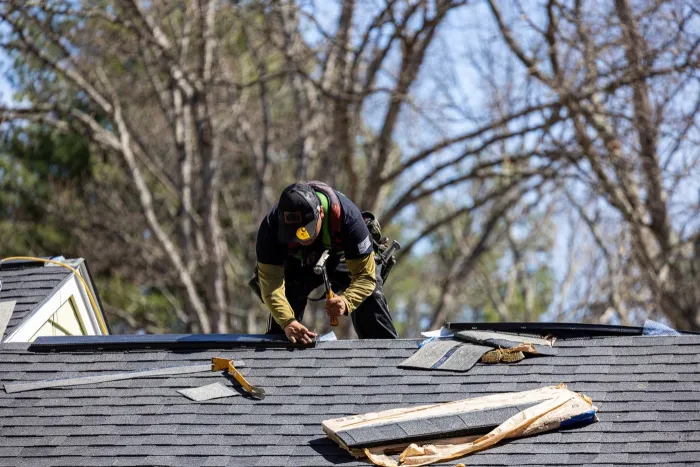
A missing shingle costs very little to replace. What makes a roof repair expensive is water reaching wood. Once it gets past the shingles it soaks the underlayment, then the roof deck, then the insulation and the ceiling below, and every one of those layers costs more to fix than the one above it.
Water also travels. It runs along a rafter or the underside of the roof boards before it drips, so the stain on your ceiling is often several feet from where the water got in. By the time you see it inside, it's usually been getting in for a while.
And in Massachusetts, winter makes it worse. Water that gets under a lifted shingle in November freezes, expands, and opens the gap a little wider every cold night. A repair that was one shingle in the fall can be a section of rotted decking by April.
These are the early ones, the signs that show up while a repair is still small.
If water is already coming inside, you're past the early stage. Call us at 978-647-3626; our roof repair crew holds a 48-hour response time on repair calls.
None of these needs you on the roof.
Some of what gets done to roofs in the name of maintenance shortens their life.
A look from the ground catches the obvious problems. An inspection catches the ones that become expensive. When we inspect a roof we check the shingles slope by slope, the flashing at every chimney, wall, and vent, the valleys, any soft spots in the decking, and the attic ventilation. Then we tell you what needs fixing now, what can wait, and what to keep an eye on.
The inspection is free, and once a year is a good rhythm for most houses. If your roof came through a hard winter or a big storm, add one after it. Our winter roof checklist covers what to look at before the snow.
Keeping repairs small works for most of a roof's life. Near the end of it, the repairs start coming closer together, and that's the sign to start planning a replacement instead of paying for the next patch. Our guide to roof repair or replacement covers how to tell, and the 25% roofing rule explains why about a quarter of the roof is the usual tipping point.
Every repair is different, so we don't quote one over the phone. The assessment is free, and financing on repairs starts at 0% for 12 months through GreenSky. Details are on our financing page.
· 81 Google Reviews · 48-hour response on repair calls · Free, no-obligation. We reply within 24 hours.
Roof maintenance questions we get all year
The early signs are a missing or lifted shingle, bent or cracked flashing around the chimney, a cracked rubber collar around a plumbing vent, heavy granules at the bottom of a downspout, and dark spots or damp insulation in the attic. A stain on a ceiling or an upper wall means water is already inside, and the repair is more urgent. Ice dams last winter are worth an inspection even if nothing leaked.
Once a year is a good rhythm for most houses, plus a look after any storm with strong wind or hail. Spring is a good time, because you can see what the winter did. You can check from the ground with binoculars twice a year yourself. Our roof inspection is free.
Only as a temporary patch. Roof cement cracks as it ages and weathers, and once it does it traps water behind it instead of keeping it out. It also hides the real problem, which is usually failed flashing or a damaged shingle. A proper repair replaces the flashing or the shingle and leaves no tar behind.
On a low, single-story roof in dry weather, some homeowners do. The hard part is getting the new shingle under the row above without cracking it and nailing it where the nails will be covered. A mistake there causes the next leak. Matching the color on an older roof is also tricky. If the roof is steep, two stories up, or the shingles are cold and brittle, leave it to a crew with harnesses.