
What Heavy Snow Loads Can Do to Your Roof Structure
How a winter's worth of snow and ice stresses a roof, and the warning signs to watch for.
Read more →Snow depth tells you less than you'd think. What matters is weight, and a foot of wet March snow weighs several times what a foot of January powder does. Here's what the state code says, what snow weighs, and how to take load off a roof without getting on it.
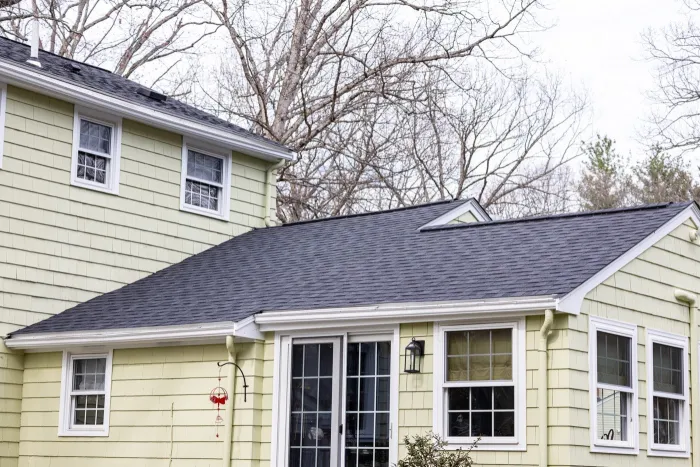
The Massachusetts State Building Code, 780 CMR, lists a ground snow load for every city and town in Table 1604.11. For Tewksbury, Billerica, Lowell, Chelmsford, Andover, Wilmington, Dracut, Methuen, and North Reading, that number is 50 pounds per square foot. Boston, closer to the water, is listed at 40. The same table sets a minimum flat-roof snow load of 30 pounds per square foot for all of those northern Middlesex and Essex County towns.
Those numbers are design inputs. Ground snow load describes how much snow an engineer has to plan for on the ground in our area, and the design load on a roof is worked out from it, adjusted for things like pitch, wind exposure, and whether the roof is heated from below. Nobody painted a weight limit on your rafters.
Your house was also framed to whatever code applied the year it was built, by whoever built it. A lot of homes around Tewksbury and Billerica have been through additions, dormers, and attic conversions since then, and a rafter cut for a skylight or a collar tie removed to make headroom changes how the roof carries weight. So the code tells you what a new roof here is designed for. It can't tell you how many inches your particular roof will hold, and nobody can from the driveway.
FEMA's Snow Load Safety Guide puts one foot of fresh snow at about 3 pounds per square foot when it's light and dry, and up to about 21 pounds per square foot when it's wet and heavy. Ice is heavier again: an inch of it weighs a little under 5 pounds per square foot, and a foot of ice about 57. FEMA also notes that snow in the eastern U.S. tends to be heavier than the drier snow out west.
Run the arithmetic on FEMA's figures and two feet of wet, heavy snow comes to roughly 42 pounds on every square foot of roof, before any ice. That's why depth is a poor guide on its own. Three things make a snowpack heavier than it looks:
Snow rarely sits evenly. Wind strips one side of a ridge and drops the snow on the other. A lower roof under a taller one, like a garage or a porch below the main house, catches drifts and whatever slides off above it. Valleys, the uphill side of chimneys, and flat or low-slope sections hold snow longest. When we're called about a roof under load, those are the spots we look at first.
On most houses, the part that matters is the bottom few feet. Pulling the lower three or four feet clear after a big storm takes weight off the overhang, where the framing has the least support, and removes the snow an ice dam is built from. You don't need to clear the whole roof, and from the ground you can't.
Raking has limits. A two-story roof is out of reach, and on a flat or low-slope roof the snow has nowhere to slide. If a flat porch or garage roof is carrying a foot or more of heavy snow, or drifts have built up against a wall, that's a job for a crew with the right equipment.
A roof under too much load usually says so before anything fails. Call right away if you notice any of these, and keep people out of the rooms under that part of the roof until it's been looked at:
Our older post on what heavy snow loads do to a roof structure goes deeper on those warning signs. For removal, our ice dam and roof snow removal crews clear the eaves, valleys, drifts, and flat sections with roof-safe tools, never a shovel dragged across shingles, and we hold a 48-hour response on those calls across Tewksbury, Billerica, and the surrounding towns all winter. The assessment is free.
If you'd like the roof looked at before the snow flies, fall is the time. A free inspection now covers the framing you can see from the attic, the flashing, and the eaves, and it gives you a plan for the winter instead of a phone call in a storm.
· 81 Google Reviews · 48-hour response on repair calls · Free, no-obligation. We reply within 24 hours.
Roof snow questions we hear every winter
The Massachusetts State Building Code, 780 CMR Table 1604.11, lists a ground snow load of 50 pounds per square foot for Tewksbury, and the same for Billerica, Lowell, Chelmsford, Andover, and the other nearby towns, with a minimum flat-roof snow load of 30 pounds per square foot. Those are design inputs for new construction. How much your own roof can carry depends on how it was framed and what has changed since.
FEMA's Snow Load Safety Guide puts a foot of fresh snow at about 3 pounds per square foot when it's light and dry, and up to about 21 pounds per square foot when it's wet and heavy. An inch of ice adds a little under 5 pounds per square foot. Rain falling on an existing snowpack makes it heavier without making it deeper.
The lower three or four feet above the gutter. That takes weight off the overhang and removes the snow an ice dam forms from. Use a roof rake with a plastic blade or rollers, pull straight down the slope, leave an inch on the shingles, keep the pole clear of the power line, and stay on the ground.
We don't recommend it. A snow-covered roof is slick, the edge is hard to see, and a metal shovel damages shingles. Rake what you can reach from the ground, and call a crew for two-story roofs, flat roofs with heavy snow, drifts against walls, or any roof showing signs of strain.