
How Clogged Gutters Cause Roof Leaks
The path water takes from a blocked gutter to a ceiling stain, and why it shows up where it does.
Read more →Leaves look harmless on a roof. Give them a wet October and they hold water against your shingles, pack the gutters solid, and set up the ice dam you'll be calling about in January. Here's what to do now, and you can do most of it from the ground.
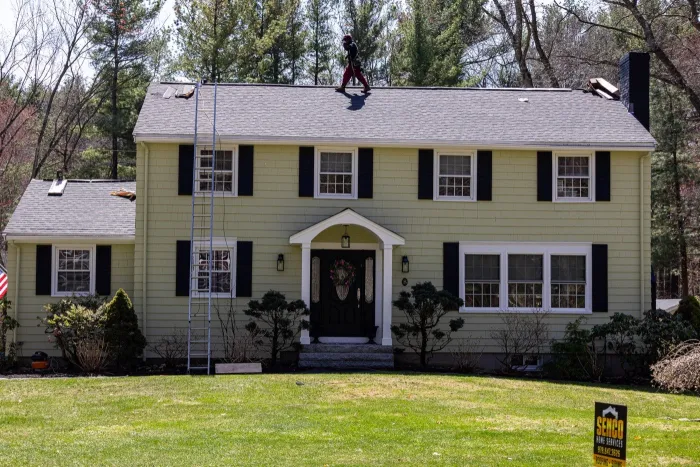
A dry leaf blowing across a roof does nothing. The trouble starts when leaves settle and get wet: in the valleys where two roof planes meet, on the uphill side of a chimney, along the eave, and anywhere the pitch is low enough for them to stay put. A wet leaf mat never dries out. It holds water against the shingles for days after the rain stops, and shingles are built to shed water, not to sit in it.
Under a wet leaf pile the shingle surface stays damp, the granules loosen, and moss and algae get the constant moisture they need. Over a few seasons the roof deck under that spot stays damp too. On a tear-off, the black, soft plywood we find most often is along the eave and in the valleys, and a good share of it started with leaves that nobody could see from the driveway.
Around Tewksbury and Billerica the roofs that suffer most sit under mature oaks and maples, which is most of the older neighborhoods. Maples drop early and fast. Oaks hang on into November and then drop after everyone has already cleaned their gutters once.
The gutter is where leaves do their most expensive work. A gutter packed with leaves stops carrying water, so a storm that should run down the downspout instead pours over the front edge onto the ground, or worse, backs up over the rear edge and behind the fascia board. That's how water ends up soaking the lowest course of shingles from below and rotting the wood the gutter is nailed to.
Wet leaves are also heavy. A run of gutter loaded with saturated leaves pulls on its hangers all fall, and by spring it's sagging in the middle and pulling away from the house. Once the gutter tips, it overflows even when it's clean. If the fascia behind it has gone soft, the hangers have nothing left to grip. That repair is on our siding and trim page, and it costs more than a fall cleaning would have.
This is the part most people don't connect. An ice dam forms when meltwater from higher on the roof refreezes at the cold roof edge. The melting comes from heat escaping through the attic, and that's the real cause, but a gutter full of frozen leaves is the foundation the dam builds on. Meltwater hits the clogged gutter, has nowhere to go, freezes, and the ridge grows from there.
So a gutter you didn't clean in November is still on the job in February. We wrote up the whole sequence, with a cutaway you can step through, in our guide to what causes ice dams. The short version for right now: clean gutters won't stop a leaky attic from making ice, but they take away the head start.
The last one means water is already inside. Everything above it is still a maintenance job.
Nothing on this list needs you on the shingles. A wet roof in October is slick, and a fall from a one-story eave is still a trip to the hospital.
Twice a year is the minimum for a Massachusetts house: once in late spring after the maple seeds and pollen come down, and once in late fall after the leaves. A heavily wooded lot, or one with oaks, usually needs a third pass. If you've had guards installed, one check in the fall is usually enough.
A stain on the ceiling, a soft fascia board, a gutter hanging loose: these are small repairs in October and much bigger ones in April, after a winter of freeze and thaw has worked on them. Our roof repair crew holds a 48-hour response time on repair calls across Tewksbury, Billerica, and the towns around them, and the estimate is free. If the gutters themselves have had it, most seamless gutter jobs in our area run about $3,000 to $5,000, and you can read what goes into that on our seamless gutters page.
· 80 Google Reviews · 48-hour response on repair calls · Free, no-obligation. We reply within 24 hours.
Fall roof questions we get every October
Twice a year at minimum: once in late spring after the maple seeds and pollen have dropped, and once in late fall after the leaves are down. If your house sits under oaks, plan on a third pass in late November, because oaks drop after everything else. With gutter guards installed, a single fall check is usually enough.
If you have trees within about thirty feet of the roof, usually yes. Guards cut to fit the gutter stop the bulk of leaves and twigs, so cleaning becomes a quick check instead of a scoop-out. They don't stop everything; pine needles and maple seeds still get through, and a guard that was clipped on loose can lift in a storm and make things worse. The value depends on how many leaves you're dealing with and how much you'd rather not be on a ladder in November.
Yes, over time. A wet mat of leaves in a valley or against a chimney keeps the shingles damp for days after each rain, which loosens granules, feeds moss, and eventually rots the decking underneath. Leaves in the gutter cause leaks faster, by backing water up behind the fascia and under the lowest shingles. Either way the leak usually shows up on a ceiling near an outside wall.
No. A wet roof in fall is slick, and most of the leaves that matter can be reached from a ladder with a leaf blower or a soft brush on a pole. If your roof is two stories up or steep, that's a job for a crew with harnesses. We clear roofs and gutters as part of a fall inspection, and the inspection itself is free.