
Do You Need a Permit to Replace a Roof?
What the state code says, who pulls the permit, and the building office in 12 towns.
Read more →Two things: a Construction Supervisor License for the person running the job, and a Home Improvement Contractor registration for the business that signs your contract. Here's what each one covers, what it protects you from, and how to look a roofer up on the state's own sites.
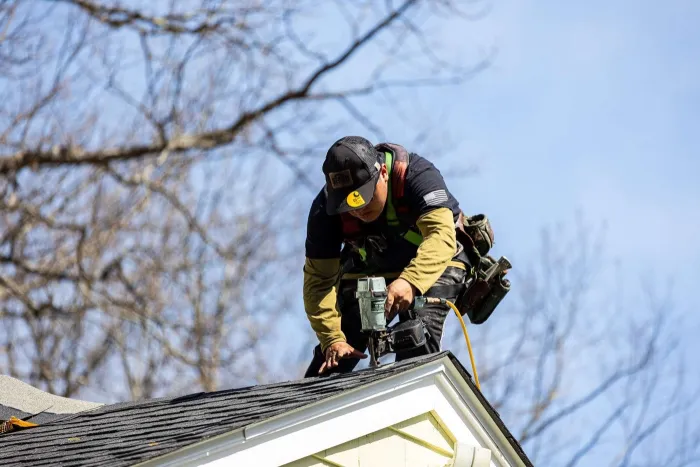
To replace a roof on a house in Massachusetts, a contractor needs a Construction Supervisor License and a Home Improvement Contractor registration. The state's own page on the subject says the two are different and not interchangeable.
The state's guidance chart for contractors gives roofing, new or replacement, one row: CSL yes, HIC yes, building permit yes, with the roofing CSL as the minimum license. There's no separate state roofing contractor license beyond those two.
The CSL comes in three kinds, and any of them can cover the roof on a house:
That last line comes up when a tear-off turns up a lot of rotted decking. Structural work past what the roof covering license allows belongs under one of the broader two, so it's fair to ask a roofer which license they hold.
To earn any of them, a supervisor needs at least three years of experience in the field and a passing score on the state exam. The first license runs three years and renewals run two, with continuing education every cycle: 12 hours for unrestricted, 10 for one- and two-family, and 6 for a specialty license.
Because the license is a person's, ask whose CSL will be on your permit and whether that person will be supervising your job.
Any contractor or subcontractor who bids on or does work on an existing, owner-occupied home with one to four units has to register with the state. Roofing isn't among the exempt trades. Registration costs $150, plus a payment into the Guaranty Fund based on the size of the company, and it renews every two years.
By law the registration number has to appear on every contract, building permit, and advertisement. If a roofer's website or estimate doesn't show one, ask for it.
The fund has conditions. You need a written contract. The contractor has to have been registered when you signed it. The house has to be your primary residence, with one to four units. And the contractor has to be the one who pulled the building permit, which our roof permit guide explains.
Operating without a registration is a crime in Massachusetts, punishable by a fine of up to $5,000, imprisonment of up to two years, or both.
Workers' compensation is required. Every Massachusetts employer has to carry it for their employees, and state law tells towns to withhold a building permit from an applicant who can't show proof. A sole proprietor with no employees isn't required to cover themselves.
Liability insurance is a separate policy. It's the one that pays if a crew damages your house or your neighbor's car. The state asks contractors for evidence of adequate insurance when they register, and it tells homeowners to ask for proof of both policies. Some towns want a certificate with the permit application as well. Tewksbury, Wilmington, and North Reading all say so.
Ask the roofer's insurance agent to send you both certificates directly.
All three checks are free and public:
Ours are MA CSL #110124 and HIC #198449, if you'd like two numbers to try the lookups with.
A license tells you a roofer is allowed to do the work. For how they'll do it, read their reviews, call a reference, and get the scope in writing. When you're ready to compare, a free roof quote from us is one place to start, and our roof replacement page lists what the job includes.
· 82 Google Reviews · 48-hour response on repair calls · Free, no-obligation. We reply within 24 hours.
License questions we hear a lot
Two credentials. The person supervising the job needs a Construction Supervisor License (unrestricted, one- and two-family, or the roof covering specialty), and the business needs a Home Improvement Contractor registration to work on an existing owner-occupied home with one to four units. A roof replacement also needs a building permit.
No. The state says they are not interchangeable. A CSL is a personal license earned by passing an exam on the building code. An HIC registration is a business registration with no exam, and it's what gives a homeowner access to state arbitration and the Guaranty Fund.
Look up the Construction Supervisor License on the state's license verification site, and the Home Improvement Contractor registration on the state's contractor registration search, which also shows complaints, arbitration results, and Guaranty Fund payouts. Workers' compensation coverage can be checked on the state's proof of coverage site.
Workers' compensation is required for any roofer with employees, and towns must withhold a building permit without proof of it. Liability insurance is a separate policy. The state asks registered contractors for evidence of adequate insurance, and some towns require a certificate with the permit, so ask for both certificates.
Up to $25,000 of actual loss, raised from $10,000 by a 2024 law. It applies when a homeowner wins a judgment or arbitration award against a registered contractor and can't collect. The contractor must have been registered when the contract was signed and must be the one who pulled the building permit.