
Choosing Roofing Materials
3-tab, architectural, and luxury shingles, and how to pick a roof color.
Read more →Siding is the biggest block of color on your house, and you'll live with it for decades. Here's how to pick one you'll still like in fifteen years, how to test it first, and what to know before painting vinyl siding.
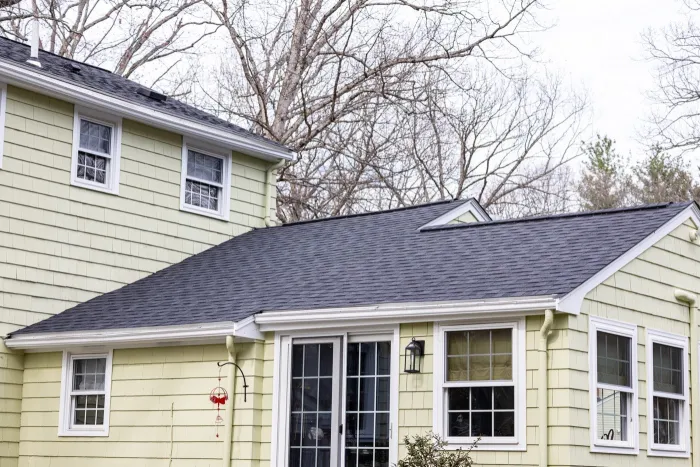
The easiest way to narrow hundreds of siding colors down to a few is to start with the parts of the house that are staying.
A house that looks finished usually has three colors working together: the siding, the trim, and an accent.
Gutters count too. We match seamless gutters to the trim color so they disappear into the roofline, which is usually what you want.
A color always looks different across a whole house than on a small chip. In full sun it reads lighter and brighter, and in shade it goes darker and cooler. So test it where it will live.
If you're replacing the roof as well, or plan to in the next few years, choose the two together. A roof lasts decades, so a shingle color that works with a few different siding colors gives you room to change the house later.
Our free Roof Color Designer puts any CertainTeed Landmark shingle color on a photo of your own house. Only the shingles change, so you can see each roof color against the siding you have now. Our guide to choosing roofing materials covers the shingle side of the decision.
A bright or trendy color can look great the year it goes up and dated a decade later. The classic range ages better, and it won't clash if you change the roof, the shutters, or the front door down the road.
Darker siding colors absorb more of the sun's heat and show fading sooner than lighter ones, especially on the south and west walls. If you love a deep color, ask about the products built to hold dark colors, and expect the sunny side to change first.
Yes, you can paint vinyl siding, with a few limits that matter.
Painting makes sense when the siding is solid, lies flat, and the only problem is the color. If the vinyl is cracked, brittle, loose, or badly faded, or if you want a darker color than it was made for, new siding is the better answer. Our guide to common winter siding problems covers what worn-out vinyl looks like.
Fiber cement and wood are a different story. Both are made to be painted, which is part of their appeal and part of their upkeep.
We install vinyl lap siding in 4-inch and 5-inch exposures, vinyl cedar impressions in 5-inch and 7-inch exposures in multiple colors, fiber cement, and wood. Our guide to vinyl lap vs cedar impression siding compares the two most popular vinyl styles.
For most homes in the Tewksbury area, new siding runs about $25,000 to $30,000, depending on the size of the house, the material, and whether the old siding comes off first. Every new siding installation includes waterproofing and free seamless gutter installation, and financing starts at 0% for 12 months through GreenSky. You can see what we install on our siding page.
· 81 Google Reviews · 48-hour response on repair calls · Free, no-obligation. We reply within 24 hours.
Siding color questions we hear at every estimate
Yes, with limits. Use an exterior paint made for vinyl, clean the siding thoroughly first, and stay the same shade or lighter than the original color. Painting can affect the siding manufacturer's warranty, so check it before you start. Once vinyl is painted it needs repainting every several years, so painting makes the most sense when the siding is in good shape and the color is the only problem.
It's risky. Vinyl expands as it heats up, and a darker color absorbs more sun. Siding painted darker than it was made for can get hot enough to warp and buckle, especially on south and west walls. Some paint makers offer darker colors rated as safe on vinyl. If you want a deep color, new siding made in that color is the more reliable route.
Usually the trim. Gutters run along the fascia, which is part of the trim, so matching them to it makes them disappear into the roofline. On a house with dark trim or no contrasting trim, matching the siding can work too. We form seamless gutters in a range of colors to match.
Get real siding samples, not printed swatches, and hold them against the house on at least two sides, including the shadiest one. Look at them in the morning, midday, and late afternoon, and from the street rather than up close. Colors look lighter in full sun and darker in shade across a whole wall than they do on a small sample.