
How Much Does a New Roof Cost in Massachusetts?
What drives the price of a roof around Tewksbury, how to read a quote, and the financing options.
Read more →An asphalt shingle roof here can last 20 to 30 years. Where yours falls in that range has more to do with the attic, the trees, and the installation than with the calendar. Here's what wears a New England roof out, and what the code says about putting new shingles over old ones.
Asphalt shingles cover most of the houses in Tewksbury, Billerica, and the towns around them, and with the right materials and installation an asphalt roof can last 20 to 30 years. Traditional 3-tab shingles sit toward the lower end of that range, at 20 years or more. Architectural shingles are thicker, with a longer expected lifespan.
The warranty is a separate question from the lifespan. A long manufacturer warranty tells you what the shingle maker stands behind and on what terms. How long your roof stays tight depends on how it was installed and what the house does to it every winter and summer.
Most of what you can control comes down to upkeep. Keep the gutters clean so water and ice don't back up at the eaves. Cut back branches that hang over the roof. Get lifted or missing shingles fixed before winter, while it's a small job. Check the attic once a year for damp insulation, frost on the nail tips, or daylight where there shouldn't be any. A roof that gets that kind of attention reaches the top of its range far more often than one nobody looks at until it leaks.
When it needs it, which isn't the same as when it hits a certain birthday. A well-vented roof in full sun can outlast a neighbor's roof of the same age under trees. Age tells you when to start watching more closely. The roof itself tells you when it's done:
One or two of these on a younger roof is usually a repair, and our roof repair crews handle those with a 48-hour response. Several of them on a roof past 20 years is the time to plan a replacement, ideally on your schedule and in good weather instead of after a January leak. Our guide to roof repair or replacement goes through each sign, and our post on the best time of year to replace a roof helps you pick the season.
Sometimes, within limits. The Massachusetts Residential Code (780 CMR, which adopts the 2021 International Residential Code) lets a new layer of shingles go over an existing roof, called a recover, except in three cases:
Two. A roof with one layer can take a second. A roof that already has two has to be torn off to the deck before it's re-roofed. To count layers yourself, look at the edge of the roof along the gutter or the gable end, where you can often see the stacked shingle edges.
Even where a recover is allowed, it's usually the weaker job. With the old shingles left in place, nobody sees or replaces soft decking. The new shingles take on every bump of the layer below, the flashing has to be worked around old material, and the ice and water barrier that protects the eaves can't go down on bare wood. The roof carries the weight of both layers, too.
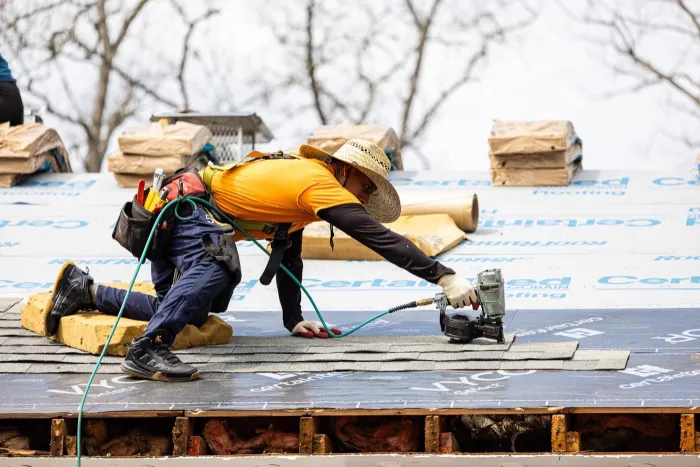
That's why every replacement we do is a full tear-off: the old roof comes off, we inspect and repair the deck, and new underlayment, flashing, and CertainTeed shingles go on, backed by a 50-year materials and labor warranty from CertainTeed and our own 10-year workmanship warranty. The details are on our roof replacement page, and a free roof quote tells you how many layers you have and what it'll take.
· 81 Google Reviews · 48-hour response on repair calls · Free, no-obligation. We reply within 24 hours.
Roof lifespan questions we hear a lot
With the right materials and installation, an asphalt shingle roof can last 20 to 30 years. Traditional 3-tab shingles sit toward the lower end, and architectural shingles last longer. Ventilation, ice dams, shade, sun exposure, and the quality of the installation decide where a particular roof lands in that range.
Two. The Massachusetts Residential Code doesn't allow a new layer over a roof that already has two or more layers of roofing, so a roof with two layers has to be torn off before it's replaced. A recover is also not allowed over a water-soaked or deteriorated roof, or over slate, clay, cement, or asbestos-cement tile.
Code allows it over a single sound layer of asphalt shingles, but it's usually the weaker job. Nobody inspects or replaces the decking, the new shingles follow every bump in the old ones, flashing is harder to do right, and the ice and water barrier can't go on bare wood at the eaves. Senco does a full tear-off on every replacement.
When it shows it's worn out, rather than on a fixed schedule. Curling or cracking across whole slopes, bare spots and heavy granule loss, repeat leaks, soft decking, or a sagging roofline on a roof past 20 years mean it's time to plan a replacement. One or two problems on a younger roof are usually a repair.